
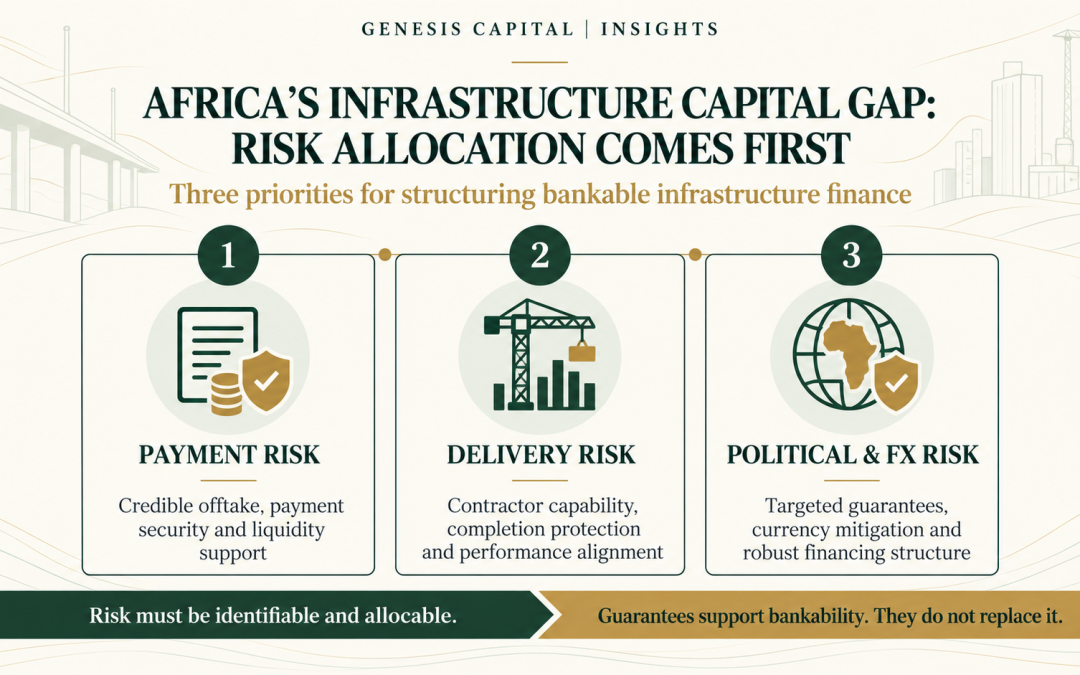
Africa’s infrastructure financing challenge is often described as a shortage of capital. This is only part of the problem.
Substantial pools of capital exist across development finance institutions, pension funds, insurance companies, infrastructure investment funds, private credit providers and sovereign-linked investors. Yet many commercially promising projects struggle to progress beyond preliminary discussions.
Why?
Because the availability of capital is not the same as the availability of projects that institutional investors can finance.
For institutional capital, the fundamental question is not merely whether a project addresses an important economic need or promises attractive returns. It is whether the underlying risks can be identified, allocated, mitigated and priced within an acceptable investment framework.
This distinction is particularly important in emerging markets, where infrastructure projects may combine construction, commercial, political, regulatory and currency exposures.
1. Why promising projects fail to secure financing
Consider a proposed renewable-energy development.
It may benefit from strong electricity demand, available land, an experienced engineering contractor and attractive projected returns.
Nevertheless, lenders may decline to proceed because:
- The electricity purchaser lacks sufficient creditworthiness.
- The power purchase agreement does not provide adequate payment protection.
- The sponsor’s equity contribution is uncertain.
- Grid-connection rights or essential permits remain unresolved.
- The project earns local-currency revenues but requires foreign-currency debt.
- Construction completion risks are insufficiently allocated.
None of these deficiencies necessarily means the underlying project lacks economic value.
They indicate that the project has not yet been structured to satisfy the requirements of its intended capital providers.
Investors cannot simply rely on projected returns. They must understand what happens when actual performance differs from the financial model.
2. The five risks that require careful allocation
Commercial and payment risk
Infrastructure lenders place considerable importance on the predictability and collectability of project revenues.
A long-term contract can create revenue visibility, but contractual duration alone is insufficient.
The investor must assess the counterparty’s financial strength, payment obligations, termination provisions and enforceability.
A power project selling electricity to a financially constrained utility may require additional protections, potentially including payment security, escrow arrangements, letters of credit or appropriately structured guarantees.
The appropriate protections depend on the transaction and the creditworthiness of the parties.
Construction and completion risk
A commercially attractive project may still become financially distressed if construction costs increase, delivery is delayed or technical performance falls below expectations.
Lenders therefore examine engineering, procurement and construction contracts, completion obligations, cost-overrun provisions, performance guarantees, contractor credentials and contingency budgets.
The objective is to establish who bears the financial consequences of delays, defects or underperformance.
A credible construction framework can materially strengthen financing prospects.
Political and regulatory risk
Government approvals, concession arrangements, tariff regulation and changes in law can influence a project’s long-term economics.
In some jurisdictions, political-risk insurance or guarantees may mitigate defined exposures.
However, such instruments are contract-specific. Their coverage, exclusions, claims procedures and eligibility requirements must be understood before assuming that a risk has been transferred.
Currency and convertibility risk
Where project revenues are collected in local currency but financing is denominated in United States dollars or euros, currency depreciation may undermine debt-service capacity.
Currency convertibility and transfer restrictions can create additional challenges.
Possible mitigants include local-currency financing, appropriate hedging, contractual indexation or financing structures that match currency exposures more closely.
These solutions involve costs and limitations and may not be commercially available for every jurisdiction or tenor.
Operational and performance risk
Even after construction is completed, an infrastructure asset must operate reliably.
Lenders assess operating contracts, maintenance arrangements, equipment warranties, insurance coverage, replacement expenditure and management capability.
An attractive financial model provides little protection if the asset cannot consistently deliver the service on which its revenues depend.
3. What guarantees can—and cannot—achieve
Guarantees and credit-enhancement instruments can play an important role in mobilising institutional capital.
Properly structured, they may address specific political, payment or credit risks and improve the predictability of cash flows.
Their presence may support longer lending tenors, stronger lender participation or more competitive financing terms.
However, their effectiveness depends on the underlying project and on the precise coverage offered.
A guarantee cannot independently create demand for an uncompetitive service, rectify an unrealistic tariff, compensate for absent sponsor equity or substitute for essential regulatory approvals.
This is why guarantee eligibility should be evaluated during financing design rather than introduced only after conventional lenders have rejected the transaction.
Credit enhancement is most effective when it strengthens an otherwise commercially coherent and technically credible project.
4. Risk allocation must follow the ability to manage risk
A fundamental principle of sound project financing is that risks should, wherever practical, be borne by parties with the capacity and incentives to control or manage them.
Construction risk may be allocated to an appropriately qualified contractor, subject to realistic contractual obligations and limitations.
Operating performance may be assigned to an experienced operator.
Payment obligations should rest with counterparties capable of meeting them, supported by suitable protection where necessary.
Sponsors must retain appropriate exposure through credible equity commitments, completion support or other agreed obligations.
Risk allocation is not simply the process of transferring every possible liability away from the sponsor.
If contractual obligations become commercially unrealistic, the result may be an unfinanceable project or a structure vulnerable to disputes.
The objective is a balanced arrangement that remains viable for all essential counterparties.
5. Why financing design should begin early
Many project sponsors approach institutional investors with a detailed financial model and an ambitious capital-raising target, expecting the financing structure to develop during negotiations.
This approach can prove expensive.
Potential financiers may identify fundamental deficiencies after considerable time has already been spent on introductions, presentations and preliminary diligence.
A more effective sequence begins with an institutional-finance readiness assessment.
Sponsors should establish:
- Whether demand and revenues are sufficiently evidenced.
- Whether the principal contracts support the proposed financing structure.
- Whether sponsor equity is credible and available.
- Whether technical, regulatory and delivery requirements are sufficiently advanced.
- Whether major risks have practical, commercially realistic mitigants.
- Whether projected cash flows can withstand reasonable downside scenarios.
- Whether the proposed debt and equity instruments match the project’s actual stage of development.
These questions help distinguish a potentially attractive development from a transaction capable of progressing toward investment approval.
6. The strategic implication for African infrastructure
Africa’s infrastructure opportunity is substantial, but financing success cannot be measured solely by the capital committed to investment funds or announced through financing initiatives.
The critical conversion occurs when projects move from commercial concepts into executable financing structures.
That requires credible sponsors, properly allocated risks, dependable revenues, sound governance and documentation capable of institutional scrutiny.
It also requires identifying the right capital instrument.
Development-stage equity, construction debt, operating-asset refinancing and credit-enhanced lending serve different purposes and involve different risk expectations.
Attempting to secure long-term project debt before the underlying commercial or contractual risks have been sufficiently resolved may be premature.
The objective should not simply be to attract investor attention. It should be to prepare projects that institutional capital can finance with confidence.
For project sponsors, the most effective capital-raising strategy may therefore begin well before the first investor meeting.
Genesis Capital perspective
Genesis Capital works with project sponsors and businesses to evaluate institutional-finance readiness, identify material transaction risks, structure financing opportunities and approach suitable capital providers.
Our focus is on bridging the gap between commercially promising projects and the requirements of institutional capital.
Related LinkedIn discussion: Africa’s Infrastructure Financing Challenge Requires Better Risk Allocation — Puneet Narula
This article is intended for general information and does not constitute investment, legal or financial advice.