
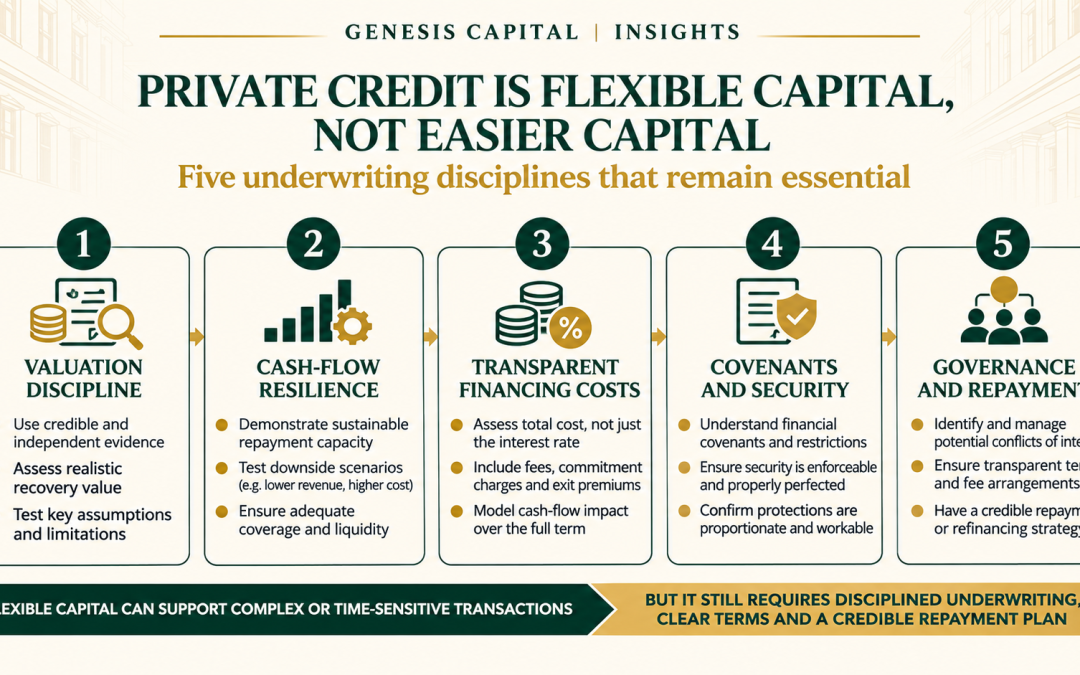
Why financing flexibility must be matched by stronger underwriting discipline
Private credit has become an important financing alternative for businesses, project sponsors and investors seeking solutions beyond conventional bank lending.
Its appeal is understandable.
Private lenders may be able to structure financing around acquisition timetables, complex assets, transitional cash flows or particular borrower requirements. Negotiations can be more tailored, decision-making may involve fewer parties and confidentiality can be easier to maintain.
For borrowers facing time-sensitive opportunities, this flexibility can be valuable.
However, a fundamental distinction is frequently overlooked.
Flexibility in financing structure does not mean flexibility in the evidence required to support the financing.
A lender willing to consider a complex transaction is not necessarily willing to accept an inadequately supported valuation, uncertain repayment capacity or poorly documented security.
In many cases, private lenders compensate for additional risks through higher pricing, tighter covenants, enhanced security and greater contractual control.
The central question for borrowers is therefore not simply whether private credit is available.
It is whether the proposed structure improves the transaction’s financial and strategic position after accounting for its full economic cost and contractual obligations.
1. What makes private credit different?
Private credit generally refers to debt financing provided by non-bank lenders, often through investment funds, institutional accounts or specialist credit platforms.
It encompasses several distinct strategies, including senior secured lending, direct lending, asset-backed credit, mezzanine finance and special-situation financing.
These strategies have different risk profiles, return requirements and lending criteria.
A senior secured lender financing an established business with stable cash flow may behave very differently from a special-situations investor supporting a complex restructuring.
Private credit should therefore not be treated as one uniform financing product.
Its principal advantage is the possibility of tailoring the financing instrument to a transaction’s specific circumstances.
Borrowers may negotiate the maturity, repayment schedule, security package, pricing mechanism and covenant structure within the lender’s investment parameters.
This may be particularly relevant for acquisitions, business expansion, refinancings and assets with unusual characteristics.
However, the lender’s ability to negotiate bespoke terms does not remove the need to establish a credible source of repayment.
2. Valuation must be supported by evidence
A central question in private-credit underwriting is whether the value assigned to a company or asset is defensible.
Borrowers may point to recent valuations, estimated replacement costs, projected business growth or transactions involving comparable assets.
These can be relevant indicators.
However, lenders must determine whether those values provide appropriate protection if the borrower cannot meet its obligations.
An asset’s headline market value does not necessarily equal the amount that could be recovered during an enforcement process.
Recovery may depend on the asset’s liquidity, legal ownership, existing security interests, operating condition, market demand and the time required to complete a sale.
For specialised infrastructure and industrial assets, recovery value may be particularly sensitive to whether the asset can continue operating or be transferred to another owner.
The Australian Securities and Investments Commission has highlighted concerns about valuation practices in parts of the private-credit market, including the quality, independence and transparency of valuation processes.
Its September 2025 report also identified concerns relating to conflicts of interest and opaque remuneration arrangements.
These findings reinforce a principle relevant to both lenders and borrowers:
A valuation is useful for financing only when its assumptions, methodology and limitations can withstand scrutiny.
Borrowers should therefore prepare appropriate valuation evidence rather than relying solely on figures contained in investment presentations.
3. Cash-flow underwriting remains fundamental
Even where significant collateral is available, lenders generally need confidence that the financing can be serviced and repaid.
For established businesses, this requires analysis of operating cash flow, working capital, financial leverage and the resilience of earnings.
For asset-backed transactions, lenders also evaluate the reliability of the underlying asset’s income and the enforceability of the security structure.
For development-stage infrastructure, the repayment analysis may be more complex because construction must be completed before the project generates operating revenue.
In these circumstances, lenders may require committed sponsor equity, defined construction obligations, liquidity support and clearly identified project milestones.
A financing structure that appears sustainable under optimistic assumptions may become difficult to service if revenue declines or the project experiences delays.
Consider a hypothetical borrower generating $12 million in annual cash flow available for debt service against $8 million in scheduled debt payments.
Its debt-service coverage ratio is 1.50 times.
If cash flow declines by 20%, while debt-service obligations remain unchanged, coverage falls to 1.20 times.
That reduction could substantially affect covenant headroom and financing resilience.
The precise consequences depend on the financing agreement, but the illustration demonstrates why downside scenarios matter.
Financing capacity should be determined by sustainable repayment ability, not merely the amount a lender is initially prepared to advance.
4. The true cost of private credit goes beyond interest
One of the most important considerations for borrowers is the total economic cost of financing.
A private-credit proposal may specify an annual interest rate, but additional contractual terms can materially affect the effective financing cost.
These may include arrangement fees, commitment fees, monitoring charges, payment-in-kind interest, prepayment premiums, exit fees or equity-linked participation.
For example, a financing facility with a relatively attractive cash-interest rate may also include upfront fees and an exit payment.
The resulting total cost can differ considerably from the headline interest rate.
Payment-in-kind interest, where permitted, may reduce immediate cash payments but increase the amount outstanding over time.
Borrowers should therefore evaluate the financing through a cash-flow model covering its full contractual life.
The analysis should incorporate all expected payments, fees, amortisation, repayment obligations and any equity-related economics.
It should also consider whether refinancing is realistically achievable at maturity.
A financing solution that preserves ownership today may prove expensive if it creates an unsustainable refinancing obligation several years later.
5. Covenants and control rights matter
Private-credit agreements can contain extensive provisions designed to protect lenders against deterioration in borrower performance.
These may include financial covenants, reporting obligations, restrictions on additional debt, limitations on distributions and requirements concerning asset disposals.
The structure may also provide lenders with consent rights over material corporate actions.
Such protections can be commercially reasonable, particularly where a transaction involves elevated risk or limited secondary-market liquidity.
However, borrowers should understand how these provisions affect operating flexibility.
A business seeking capital to accelerate growth may find that restrictive covenants limit its ability to pursue acquisitions or finance additional expansion.
Similarly, a project sponsor may face limitations on distributions, changes in project scope or the use of operating cash.
The principal issue is not whether the lender has contractual protections.
It is whether those protections are proportionate, transparent and compatible with the borrower’s business plan.
Before signing, borrowers should evaluate both expected performance and credible downside scenarios against the proposed covenants.
They should also understand the consequences of covenant breaches and the rights that may become available to lenders following an event of default.
6. Security arrangements must be enforceable
Security can be a defining feature of private-credit transactions, particularly those involving physical assets or operating businesses.
However, creating a security package is not the same as establishing that the security can be effectively enforced.
Lenders need to understand ownership, existing liens, legal priority and the practical mechanisms through which collateral could be realised.
Cross-border transactions may introduce additional complexity because security arrangements must operate across different legal and regulatory systems.
For infrastructure assets, recovery value may depend on licences, concessions, contractual rights and the ability to continue operating essential services.
Where collateral is held through a special-purpose vehicle or operating subsidiary, lenders should establish how the relevant ownership and security interests interact.
Borrowers should therefore seek appropriate legal and financial advice before assuming that identified asset value provides sufficient borrowing capacity.
A credible security structure should align the economic substance of the financing with enforceable legal rights.
7. Governance and conflicts of interest cannot be ignored
The governance of private-credit arrangements is relevant to borrowers as well as investors.
Complex structures may involve multiple financing entities, related-party transactions, intermediary fees or investors holding different positions within the same capital structure.
These arrangements can create conflicting incentives.
For example, different lenders may have competing interests concerning refinancing, additional borrowing or enforcement.
Where a fund manager has economic interests across multiple financing layers, transparency and appropriate governance become particularly important.
The Australian Securities and Investments Commission has identified concerns in parts of the private-credit sector involving valuation practices, conflicts of interest, disclosure and governance.
In its statement of 29 October 2026, the regulator again emphasised the importance of oversight, accurate valuations and clear disclosure following difficulties affecting certain Australian private-credit exposures.
While those findings relate to the Australian market, the underlying governance considerations are relevant to private lending more broadly.
Private negotiations should allow flexibility without compromising clarity about fees, responsibilities, related-party interests and creditor rights.
8. When private credit is an appropriate financing solution
Private credit can be valuable when conventional bank finance does not adequately accommodate a transaction’s commercial requirements.
For example, an acquisition may require financing within a timetable that is difficult for a traditional lending syndicate to meet.
An established company may need additional capital for expansion but wish to avoid immediate equity dilution.
An asset-backed business may require a repayment structure reflecting its underlying contractual cash flows.
In other cases, a borrower may require temporary financing while preparing for refinancing, an asset sale or a longer-term funding solution.
Each situation can justify considering private credit.
However, the financing must remain aligned with the borrower’s cash-generating capacity and realistic exit options.
Private credit is not necessarily appropriate for a project with no credible repayment source, unresolved ownership issues or financing assumptions that remain unsubstantiated.
The availability of flexible capital should not be used to avoid addressing deficiencies in the underlying investment case.
9. Five questions borrowers should answer before accepting private credit
Before proceeding with a private-credit proposal, borrowers should examine five areas.
1. Is the valuation independently defensible?
The business or asset valuation should be supported by credible financial, commercial or market evidence.
2. Can the financing be serviced under downside conditions?
The financial model should incorporate realistic reductions in revenue, increases in cost and delays in expected cash generation.
3. Is the complete financing cost transparent?
The borrower should understand interest, fees, repayment premiums, equity-linked economics and any other contractual payments.
4. Are the security, covenants and control rights acceptable?
The financing agreement should protect lenders without imposing obligations that undermine the borrower’s ability to execute its commercial plan.
5. Is the repayment or refinancing strategy credible?
The borrower should have an identifiable route to repay, refinance or otherwise discharge the financing at maturity.
These questions provide a practical starting point for evaluating whether the proposed financing is commercially sustainable.
10. Why the right adviser should challenge the structure
A financing adviser should not assess private-credit proposals solely on the amount offered or the expected speed of execution.
The more important task is to determine whether the financing meets the sponsor’s objectives and can be sustained under realistic conditions.
That requires evaluating the instrument’s pricing, repayment profile, security arrangements, covenant restrictions, governance provisions and downside protections.
An adviser may conclude that private credit is appropriate.
Alternatively, the transaction may be better suited to conventional senior debt, structured equity, strategic investment or a combination of different financing instruments.
In some cases, the correct recommendation is to defer the financing process until commercial assumptions, financial documentation or sponsor commitments have been strengthened.
The objective should be to obtain suitable capital, not simply available capital.
Conclusion: Flexibility should strengthen financing design
Private credit can provide meaningful advantages where conventional lending structures are too restrictive or insufficiently responsive to a transaction’s requirements.
Its value lies in the ability to tailor financing to the underlying business, asset or project.
However, bespoke structures require disciplined analysis.
Borrowers must understand what they are paying, which risks remain with them, what rights they are granting to lenders and how the financing will ultimately be repaid.
Private lenders, in turn, require credible valuations, sustainable cash flows, enforceable protections and transparent governance.
Flexibility changes the financing structure. It should never weaken the evidence supporting it.
Genesis Capital perspective
Genesis Capital advises companies and project sponsors on capital structuring, institutional financing readiness, private-credit solutions and access to suitable capital providers.
Our approach emphasises the economic and contractual implications of financing decisions, including repayment resilience, risk allocation, security and investor alignment.
We believe that a well-designed financing structure should support the underlying commercial strategy while remaining sustainable under realistic downside scenarios.
Related LinkedIn discussion: Private Credit Flexibility vs Underwriting Discipline — Genesis Capital
Further reading:
Australian Securities and Investments Commission — Private Credit in Australia, Report 814
Australian Securities and Investments Commission — Supplementary Budget Estimates, 29 October 2026
This article is for general information only and does not constitute financial, investment, legal or tax advice. Financing terms, risks and regulatory requirements vary by transaction and jurisdiction.