
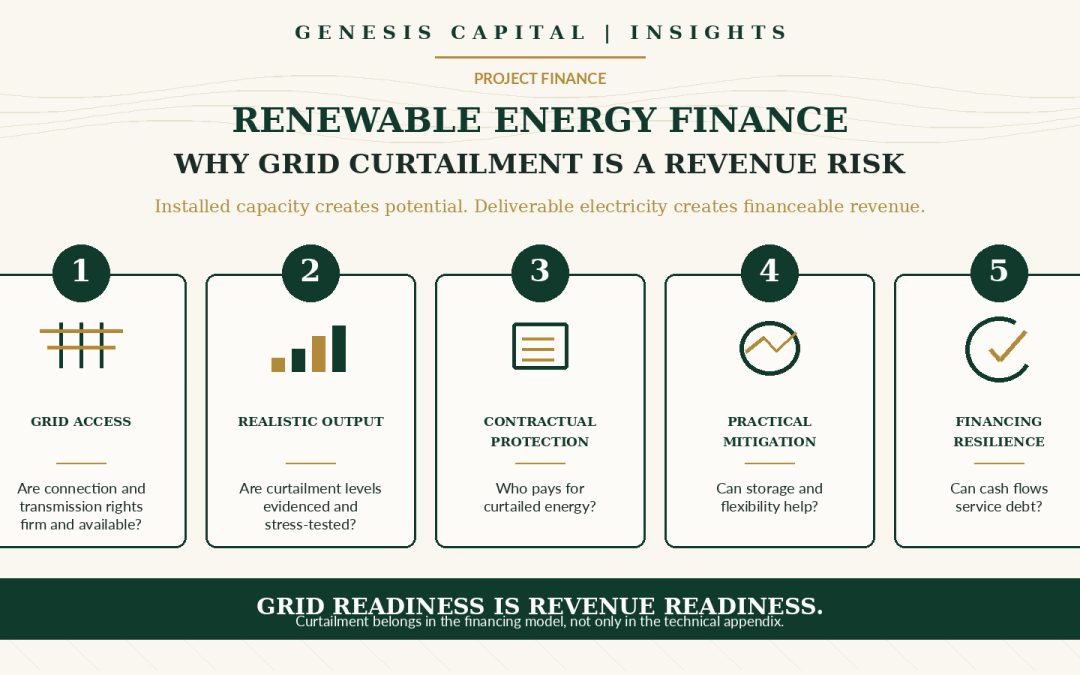
Installed generation capacity does not automatically translate into financeable electricity revenues
The rapid expansion of renewable energy is creating a financing challenge that is often underestimated during project development.
Solar and wind projects may have secured land, completed feasibility studies, obtained generation licences and entered into long-term electricity purchase agreements. Yet one critical question can remain unresolved:
Can the electricity generated by the project actually be delivered to the grid and converted into revenue?
The distinction is fundamental.
A renewable-energy project can generate electricity that the transmission network cannot accommodate. When grid congestion, system stability requirements or mismatches between electricity supply and demand prevent that electricity from being accepted, the project may be instructed to reduce output.
This is commonly described as curtailment.
For project sponsors, curtailment may initially appear to be a technical or operational matter.
For institutional lenders and equity investors, however, it is a potentially material source of revenue risk.
Installed capacity creates generation potential. Deliverable electricity creates financeable revenue.
1. Why grid curtailment matters to institutional investors
Renewable-energy financing depends heavily on the reliability of projected cash flows.
Lenders assess whether the project can generate sufficient revenue to meet operating expenses, maintain essential reserves and service its debt.
Equity investors examine how actual electricity sales translate into operating earnings, distributable cash flow and investment returns.
Curtailment can affect both.
A project may achieve its expected technical availability while still selling less electricity than originally forecast.
The difference between technically available generation and commercially deliverable electricity becomes particularly important when financing models assume high utilisation or limited transmission constraints.
The International Energy Agency’s Renewables 2025 report recognises that curtailment can reduce developer revenue, discourage future investment and create costs where curtailed generation must be compensated.
Its Electricity 2026 analysis also highlights increasing congestion in electricity networks as renewable deployment outpaces grid investment.
These developments mean that grid integration can no longer be treated simply as a technical appendix to a financing proposal.
It must be incorporated into the project’s commercial assumptions, financial model and financing documentation.
2. The difference between generation capacity and bankable output
Consider a hypothetical 150-megawatt solar project.
Assume the following:
- Installed capacity: 150 megawatts
- Expected annual net generation before curtailment: 300,000 megawatt-hours
- Electricity tariff: $70 per megawatt-hour
- No compensation for curtailed electricity
Under these assumptions, the project’s annual electricity revenue before curtailment would be $21 million.
Now consider the effect of different curtailment levels.
| Curtailment | Electricity sold | Annual revenue | Revenue lost |
|---|---|---|---|
| 0% | 300,000 MWh | $21.00m | — |
| 5% | 285,000 MWh | $19.95m | $1.05m |
| 10% | 270,000 MWh | $18.90m | $2.10m |
| 15% | 255,000 MWh | $17.85m | $3.15m |
Illustrative calculations only. These are not forecasts for an actual Genesis Capital transaction.
At 10% curtailment, the project loses $2.1 million in annual revenue.
This reduction may represent a substantially greater percentage of distributable cash flow because many operating expenses, financing obligations and contractual commitments do not decline proportionately with electricity sales.
Over a long financing period, persistent curtailment can materially affect debt-service capacity and shareholder returns.
A project that appears bankable under an optimistic generation forecast may become considerably less attractive when realistic grid constraints are introduced.
3. How curtailment affects debt-service coverage
For project lenders, a central consideration is whether available cash flow can meet scheduled principal and interest payments.
The debt-service coverage ratio measures the relationship between cash flow available for debt service and scheduled debt-service obligations.
Suppose a project is expected to produce $15 million of annual cash flow available for debt service against $10 million of debt-service obligations.
Its projected coverage ratio would be 1.50 times.
If uncompensated curtailment reduces cash flow available for debt service by $2.1 million, with other assumptions unchanged, the ratio would fall to 1.29 times.
That difference can be consequential.
A lower coverage ratio may reduce borrowing capacity, require additional equity, increase reserve requirements or create covenant concerns.
The actual effect depends on operating costs, taxes, tariffs, contractual compensation and financing terms.
The important point is that curtailment does not merely reduce projected electricity production.
It can change the amount of debt the project can sustainably support.
This is why lenders should examine curtailment through financial downside scenarios rather than relying exclusively on engineering estimates.
4. Grid-connection rights are not the same as guaranteed dispatch
A renewable-energy developer may obtain formal permission to connect a project to the electricity network.
That approval is important, but it does not necessarily establish an unconditional right to deliver all available generation at every point in time.
The relevant questions include whether the connection is firm or non-firm, whether transmission capacity is genuinely available and which party bears the financial consequences of restrictions.
Lenders should examine:
- Executed grid-connection agreements
- Network access and dispatch rights
- Required transmission upgrades
- Completion responsibility for connecting infrastructure
- Grid-code compliance requirements
- Existing and forecast network congestion
- Historical restrictions on comparable projects
- Compensation arrangements for curtailed generation
A connection agreement may confirm the right to connect without guaranteeing uninterrupted transmission access.
Developers and financiers must therefore understand the exact contractual protections available.
For greenfield projects, this analysis should occur before substantial financing commitments are sought.
5. Why power purchase agreements may not eliminate curtailment risk
A long-term power purchase agreement is frequently regarded as a central element of renewable-energy bankability.
It may establish an electricity tariff, contractual term, payment arrangements and obligations between the generator and electricity purchaser.
However, not every power purchase agreement provides equivalent protection against curtailment.
Some arrangements may compensate the generator for defined circumstances in which electricity is available but not accepted.
Others may leave technical or economic curtailment substantially with the generator.
The definition of deemed energy or deemed generation, where applicable, can therefore be important.
Financiers should examine whether the contract establishes compensation rights, how compensation is calculated, which events are excluded and whether the payment obligation is supported by a creditworthy counterparty.
A compensation clause has limited practical value if the responsible entity cannot meet its payment obligations.
The interaction between the power purchase agreement, grid-connection agreement and applicable regulation must also be assessed.
A contracted electricity tariff does not automatically guarantee contracted electricity revenue.
6. The growing importance of storage and flexible demand
Battery energy storage can help mitigate certain forms of curtailment by storing electricity during periods of excess generation and releasing it when system conditions or market opportunities improve.
Storage may also support ancillary services, operational flexibility and more predictable delivery profiles.
However, adding batteries does not automatically eliminate curtailment risk.
The economic benefits depend on battery duration, charging opportunities, dispatch rules, degradation, operating strategy and the ability to earn revenues from stored electricity or other services.
The capital cost of storage must be justified by its expected economic contribution.
Other possible responses include:
- Improved forecasting and dispatch management
- Hybrid renewable-generation configurations
- Flexible industrial electricity demand
- Demand-response arrangements
- Transmission reinforcement
- Better alignment between generation and electricity consumption
For projects combining renewable power with data centres or industrial customers, local electricity demand may provide an additional commercial opportunity.
However, such structures require careful evaluation of customer commitments, reliability requirements, interconnection arrangements and the financial separation of individual assets.
A commercially integrated project is not necessarily best financed through a single entity or capital structure.
7. Who should bear curtailment risk?
One of the most important financing questions is how curtailment risk should be allocated.
Potentially affected parties include the project developer, grid operator, electricity purchaser and, in some circumstances, public-sector entities.
Risk allocation should reflect the contractual responsibilities and practical ability of each party to manage the relevant exposure.
A developer may reasonably bear certain risks associated with equipment performance, scheduling failures or non-compliance with technical requirements.
Network-related restrictions may involve different considerations where the generator has limited control over transmission availability.
However, transferring all curtailment risk to another counterparty may be commercially unrealistic or prohibitively expensive.
The objective should be a balanced and enforceable allocation, supported by appropriate pricing and credible compensation mechanisms where relevant.
Curtailment should not simply be assigned to whichever party has the weakest negotiating position.
Poorly allocated risk can ultimately undermine financing capacity or project execution.
8. What lenders should stress-test before financial close
Curtailment exposure should be incorporated explicitly into the financial model.
A credible financing case should evaluate not only the expected generation profile but also the sensitivity of project cash flows to restrictions on dispatch.
Relevant scenarios may include:
Base case: Curtailment assumptions supported by grid studies, operational evidence and credible forecasts.
Moderate downside: Higher curtailment arising from temporary congestion, transmission delays or changing generation patterns.
Severe downside: Sustained restrictions affecting electricity sales during an extended period.
Where contractual compensation is expected, the model should separately examine delayed payment, partial recovery and counterparty default.
Lenders should also consider whether planned grid improvements are funded, approved and realistically scheduled.
A project should not assume that a future transmission upgrade will solve its revenue constraints unless that expectation is supported by credible delivery evidence.
The financing analysis should identify the effect of each scenario on debt-service coverage, liquidity reserves, covenant compliance and potential shareholder distributions.
9. A bankability checklist for project sponsors
Before approaching institutional investors, renewable-energy developers should be able to provide evidence supporting five essential areas.
1. Grid availability and connection rights
Document the physical and contractual ability to deliver electricity, including transmission limitations and outstanding infrastructure requirements.
2. Realistic generation and curtailment forecasts
Use credible technical studies and relevant operational evidence rather than assuming uninterrupted dispatch.
3. Contractual revenue protection
Clarify who bears the financial consequences of curtailment, including the scope and creditworthiness of any compensation arrangements.
4. Practical risk mitigation
Assess whether storage, flexible demand, system upgrades or operational strategies can reduce exposure at an economically defensible cost.
5. Financing resilience
Demonstrate how the project performs when electricity delivery, revenue collection or compensation differs from the base-case assumptions.
A project unable to substantiate these matters may require additional development work before full-scale institutional fundraising begins.
10. Why grid investment is becoming part of the financing discussion
The financing implications extend beyond individual renewable-energy developments.
According to the International Energy Agency’s Electricity 2026 report, more than 2,500 gigawatts of renewable-energy, storage and large-load projects are stalled in grid-connection queues worldwide.
The agency estimates that annual grid investment needs to rise by approximately 50% by 2030 from around $400 billion to meet forecast electricity demand.
This highlights a broader investment challenge.
Expanding renewable generation without corresponding transmission capacity, system flexibility and demand integration can reduce the economic value of newly installed assets.
For investors, it reinforces the need to evaluate projects within their wider electricity-system context.
In some markets, investment in transmission, storage and enabling infrastructure may be just as important to renewable deployment as financing additional generation capacity.
Conclusion: Finance the electricity that can be delivered
The financing case for a renewable-energy project should not rest solely on installed capacity, projected generation or an agreed electricity tariff.
It must demonstrate how much electricity can realistically be delivered, sold and paid for.
Curtailment risk can affect revenue, debt-service capacity, equity returns and ultimately the viability of the proposed financing structure.
That makes grid access, contractual allocation and financial stress-testing essential elements of project preparation.
For renewable-energy developers seeking institutional capital, the most important distinction is straightforward:
Installed capacity creates potential. Deliverable output creates financeable revenue.
Genesis Capital perspective
Genesis Capital advises project sponsors on transaction readiness, project-finance structures, risk allocation and access to suitable institutional capital providers.
For renewable-energy developments, our approach emphasises the relationship between contractual revenues, grid infrastructure, sponsor commitment, technical feasibility and the financing structure.
A commercially attractive project becomes a credible financing proposition when these elements can withstand institutional due diligence.
Related LinkedIn discussion: Curtailment Risk Hampers Renewable Energy Revenue — Puneet Narula
Further reading:
- International Energy Agency — Renewables 2025
- International Energy Agency — Electricity 2026
- International Renewable Energy Agency — Renewable Energy Auctions: Design for Risk Allocation
This article is intended for general information and does not constitute investment, financial, legal or technical advice. The illustrative financial calculations are hypothetical and should not be relied upon for any actual financing decision.