
A substantial customer contract can materially strengthen a financing case.
It can demonstrate demand, improve revenue visibility and provide investors and lenders with greater confidence that the business or project will generate sufficient cash to meet its obligations.
But contracted revenue is not necessarily resilient revenue.
A company may have an impressive order book while depending heavily on one customer. A project may benefit from a long-term offtake agreement while remaining exposed to the financial strength of a single buyer. A specialised asset may generate predictable income under its current contract but have limited commercial value if that relationship ends.
This issue arises across sectors. A data centre may depend on one hyperscale tenant. A manufacturer may rely on one major purchaser. A healthcare provider may receive most of its income from a single reimbursement channel. A renewable-energy project may sell its entire output to one offtaker.
In each case, the contract strengthens financeability while potentially increasing concentration risk.
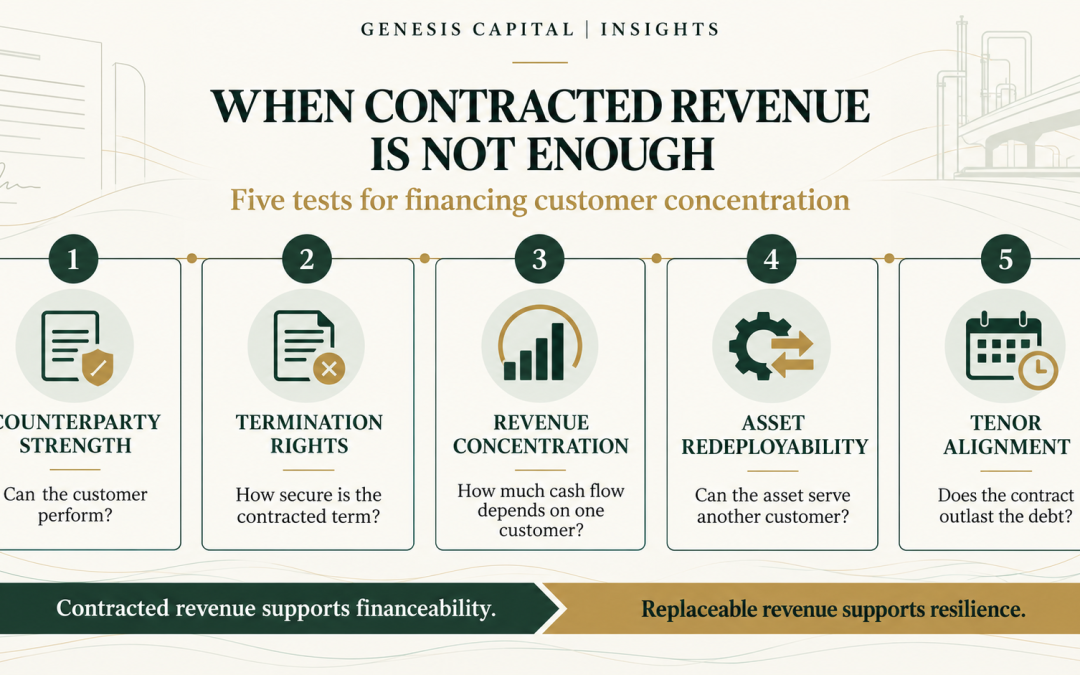
Five tests help determine whether the contracted revenue can support a credible financing structure.
1. Can the customer perform?
The first consideration is the financial and operational strength of the counterparty.
A long-term contract provides limited protection if the customer cannot meet its obligations throughout the contracted period. Investors will therefore assess the customer’s ownership, financial position, liquidity, payment history and strategic importance.
The contracting entity also matters. If the agreement has been signed by a recently incorporated subsidiary or special-purpose vehicle, the financing parties may require support from a stronger parent company.
Public-sector and utility contracts require similar analysis. Strategic importance or government ownership does not automatically guarantee timely payment. Escrow arrangements, guarantees, liquidity facilities or other payment-support mechanisms may therefore be important.
The relevant question is not simply whether a contract has been signed. It is whether the counterparty can continue performing when circumstances become difficult.
2. How secure is the contracted term?
Headline contract tenor can be misleading.
An agreement described as a ten-year contract may allow the customer to terminate earlier, reduce volumes, renegotiate pricing or withdraw if particular performance conditions are not satisfied.
The review should therefore consider:
- Termination rights;
- Minimum purchase or payment obligations;
- Renewal provisions;
- Price-adjustment mechanisms;
- Performance conditions;
- Change-of-control provisions;
- Cure periods;
- Termination payments; and
- Dispute-resolution arrangements.
Forecasts should distinguish binding contractual revenue from anticipated renewals. A renewal may be commercially likely without being legally committed.
Debt extending beyond the genuinely protected revenue period will introduce refinancing or replacement risk that must be recognised in the financing structure.
3. How much cash flow depends on one customer?
Revenue concentration should not be assessed only as a percentage of total sales.
A customer representing 40 per cent of revenue may contribute a substantially larger share of operating profit or free cash flow. The loss of that relationship could therefore have a disproportionate effect on debt-service capacity.
Concentration may also extend beyond revenue. The customer may provide technology, distribution, operating expertise, market access or another capability on which the wider business depends.
Where concentration cannot be avoided, the capital structure should reflect it. Possible responses include:
- Lower leverage;
- Faster debt repayment;
- Larger liquidity or debt-service reserves;
- Stronger financial covenants;
- Cash-sweep arrangements; and
- A greater sponsor-equity contribution.
The appropriate response depends on how quickly the business could replace the customer and restore the affected cash flow.
4. Can the asset serve another customer?
Asset redeployability is an important but frequently overlooked test.
If the principal customer leaves, can the underlying asset, capacity or service be redirected to another buyer?
A standard warehouse may accommodate several potential tenants. A specialised industrial facility built around one customer’s requirements may be much harder to repurpose. A well-located data centre with adequate power, connectivity and adaptable technical specifications may attract replacement tenants; a highly customised facility in a weaker market may not.
Investors will consider:
- The number of credible replacement customers;
- The time required to secure another contract;
- Reconfiguration or conversion costs;
- Geographic demand;
- Technological obsolescence;
- Residual asset value; and
- Management’s ability to replace the lost business.
A valuation alone does not answer these questions. The asset must remain commercially useful and capable of generating revenue under an alternative operating scenario.
5. Does the contract outlast the debt?
The relationship between contract tenor and financing tenor is critical.
A seven-year loan supported by a contract that expires after four years leaves the lender dependent on renewal, replacement or refinancing before the debt has been repaid.
A stronger structure provides sufficient protected cash flow to cover the repayment period, together with an appropriate buffer for delays or underperformance.
Where the financing extends beyond the contract, potential mitigants may include:
- Accelerated amortisation;
- Cash sweeps;
- Debt-service reserve accounts;
- Contract-renewal milestones;
- Additional customer contracts;
- Parent-company guarantees;
- Sponsor support; and
- Restrictions on distributions until concentration is reduced.
The objective is not necessarily to prevent debt from extending beyond the contract. It is to ensure that the residual exposure is understood, quantified and supported by credible mitigants.
Contracted revenue and resilient revenue are different
A significant contract can provide the foundation for financing. It can demonstrate demand, improve cash-flow visibility and reduce commercial uncertainty.
But it may also create a single point of failure.
A credible financing case should therefore answer two separate questions:
Can the existing contract support repayment?
Can the business continue meeting its obligations if that contract changes or ends?
Sponsors should address customer concentration before approaching investors, not after it becomes a due-diligence concern.
Contracted revenue supports financeability. Replaceable revenue supports resilience. Strong financing cases demonstrate both.
Genesis Capital advises companies and project sponsors on capital structure, institutional fundraising and financing readiness. Genesis Capital does not invest directly.
This article is provided for general information and does not constitute investment, legal, tax or financial advice.