
Why successful capital raising begins with financing design, not an investor list
One of the most common mistakes in capital raising is beginning with the question: Who can invest in our business or project?
For companies seeking growth capital, sponsors developing infrastructure projects and businesses undertaking acquisitions, identifying potential investors may appear to be the obvious starting point.
Yet the more important question is often left unanswered: What type of capital does the transaction actually require?
A business seeking $50 million for expansion may approach private equity funds, family offices, banks and private credit providers simultaneously. While all may have the financial capacity to consider an investment, their objectives, investment mandates, repayment expectations and risk tolerances may be fundamentally different.
Capital is not interchangeable.
A financing structure that works for an established, profitable business may be entirely inappropriate for an infrastructure development that has not commenced construction.
Similarly, a capital instrument designed for asset acquisition may not be suitable for financing product development or market entry.
The right investor is determined partly by the structure of the financing requirement—not simply by the amount being raised.
1. Understand what the capital must accomplish
Before approaching capital providers, sponsors should define the commercial purpose of the financing.
Is the funding required to construct an asset, acquire a business, support working capital, refinance existing obligations or accelerate growth?
Each objective has different implications for repayment, security, ownership and investment horizon.
Consider two companies requiring $40 million.
The first operates an established business with recurring revenue, positive operating cash flow and identifiable assets that can support security.
The second is developing a new infrastructure facility that requires substantial construction expenditure before generating revenues.
The capital requirements may be identical, but the appropriate financing instruments are unlikely to be.
The established company may be able to support senior debt or a structured credit facility.
The development-stage project may require committed sponsor equity, development capital and a financing structure that accommodates construction risk before it can attract long-term project debt.
An effective capital-raising strategy must begin by distinguishing these different risk profiles.
2. Senior debt: preserving ownership while accepting repayment obligations
Senior debt can be attractive because it allows shareholders to retain ownership while financing expansion, acquisitions or infrastructure assets.
However, lenders expect a credible source of repayment.
They normally evaluate historical or contracted cash flows, financial leverage, security, covenants, asset quality and the borrower’s capacity to service debt under downside scenarios.
For project finance, lenders may also require satisfactory construction arrangements, permits, enforceable commercial contracts and committed equity before funding can be drawn.
Debt therefore preserves ownership but introduces contractual obligations that can restrict operating flexibility.
A company with volatile cash flows or an uncertain development timetable may find conventional borrowing unsuitable, even when its long-term commercial prospects are strong.
The critical question is whether the business can support the debt without undermining its operational resilience.
3. Equity capital: financing growth without fixed repayment schedules
Equity financing can be appropriate when a business requires patient capital, is entering new markets or cannot yet support predictable debt-service obligations.
Unlike conventional debt, equity does not generally require scheduled repayment of principal.
However, this flexibility comes at a different cost.
Investors expect an ownership interest, participation in future value creation and appropriate governance rights.
Depending on the transaction, they may require board representation, information rights, reserved matters, anti-dilution protections or a defined route to liquidity.
For sponsors, the consideration is not simply the percentage of ownership being diluted.
It is whether the incoming investor’s financial and strategic objectives are compatible with those of the existing shareholders.
An apparently attractive valuation can become less compelling when the accompanying control provisions or exit expectations are considered.
Equity should therefore be assessed in terms of economic dilution, governance, strategic alignment and long-term ownership—not valuation alone.
4. Structured capital and private credit: flexibility has a price
Many businesses face financing needs that do not fit neatly within traditional senior debt or common equity.
Structured capital may provide a solution through instruments such as subordinated debt, mezzanine finance, preferred equity or combinations of debt and equity-linked returns.
Private credit providers may also offer more tailored terms than conventional bank lenders.
These structures can accommodate unusual repayment profiles, complex asset positions or transaction-specific risks.
However, flexibility should not be confused with easier financing.
Investors may require higher returns, stronger security, more extensive reporting, cash-flow controls, additional covenants or enhanced downside protection.
An instrument that appears attractive because it reduces immediate dilution can become expensive if its interest costs, redemption obligations or performance-linked returns are not fully understood.
The appropriate comparison is therefore the total economic and contractual cost of each financing option.
5. Strategic equity: capital accompanied by commercial advantages
Strategic investors can contribute more than financial resources.
An industry participant may provide access to customers, technology, distribution channels, operating expertise or new markets.
For capital-intensive industries, such relationships may strengthen commercial validation and potentially reduce execution risk.
Nevertheless, strategic investment can also introduce complications.
Exclusivity arrangements, preferential commercial rights, governance provisions or restrictions on future transactions may affect a company’s independence.
A strategic partner’s commercial interests may not always remain aligned with those of the sponsor.
The value of strategic capital must therefore be evaluated alongside the commercial dependencies and limitations it creates.
6. Export credit: matching finance with procurement
For projects involving imported equipment, machinery or technology, export-credit-supported financing may provide another route.
Depending on the transaction, an export credit agency may offer guarantees, insurance or direct financing that supports eligible exports.
This can potentially improve financing availability or terms.
However, the instrument depends on procurement eligibility, country requirements, transaction structure and the policies of the relevant export credit agency and lenders.
It is not a universal substitute for commercial project finance.
Sponsors should consider export-credit eligibility while developing procurement arrangements, rather than assuming that an established supplier relationship automatically provides access to supported financing.
7. Why mixed financing structures are often necessary
Large transactions frequently require more than one type of capital.
Consider a hypothetical $150 million infrastructure development.
The sponsor might propose $35 million of equity and $115 million of debt.
The arithmetic is straightforward, but financeability depends on much more than the proposed percentages.
Lenders must assess whether the revenue structure, completion arrangements, sponsor support and projected cash flows justify the requested debt.
Equity investors must evaluate development risk, ownership economics, governance and expected returns.
If the project incorporates different businesses—for example, a renewable-energy facility and a data centre—it may be necessary to separate their commercial arrangements, investment stages and financing structures.
The renewable-energy component may have contracted electricity revenues, while the data centre may depend on tenant commitments and phased capacity utilisation.
Combining them into a single financing vehicle does not automatically make the overall project more bankable.
An integrated commercial strategy may coexist with separate financing structures where the assets have materially different risks.
The objective is to align capital with the risk and cash-flow characteristics of each component.
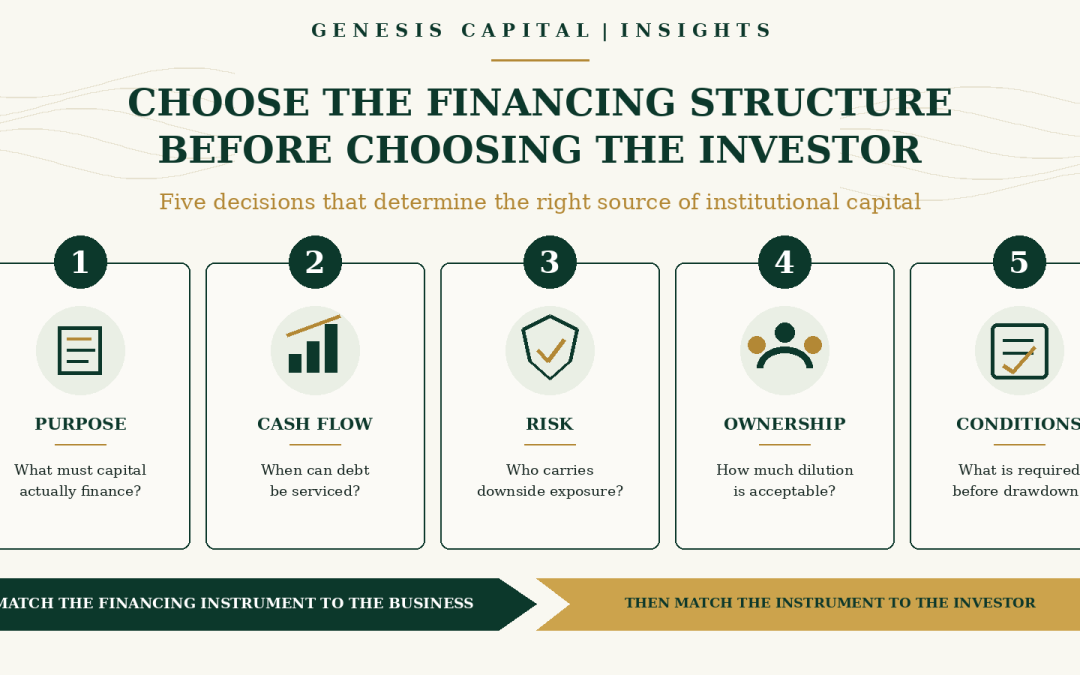
8. The four questions that should precede investor outreach
Before constructing an investor list, sponsors should be able to answer four questions.
What risk can the business currently carry?
The answer determines whether the transaction is suitable for conventional debt, development equity, structured capital or another instrument.
When will cash flow support repayment?
A business generating cash immediately has different financing capacity from one expecting revenues only after construction or commercial ramp-up.
How much ownership and control can existing shareholders accept giving up?
The preferred ownership outcome must be reconciled with the actual risks investors are being asked to assume.
Which conditions must be met before funds can be drawn?
These may include permits, commercial agreements, financing documentation, equity contributions, security perfection and other agreed conditions precedent.
A sponsor may obtain an encouraging indicative proposal but still be unable to access the capital until these requirements are fulfilled.
9. Investor selection should follow the financing structure
Once the proposed instrument has been established, investors can be evaluated against specific criteria.
These include investment mandate, geography, industry, transaction size, development stage, risk tolerance, security requirements, return expectations and governance preferences.
This approach generally produces a smaller but more relevant investor shortlist.
For example, an infrastructure debt fund focused on operational assets may have little interest in financing early-stage development expenditure.
A growth-equity investor may be unsuitable for a sponsor seeking non-dilutive financing.
A strategic investor may have the right financial capacity but require commercial rights the sponsor cannot accept.
These are structural mismatches, not necessarily weaknesses in the underlying project.
Identifying them before outreach avoids unnecessary discussions and protects relationships with capital providers.
10. Financing readiness determines whether the structure can be executed
Choosing the correct financing instrument is essential, but it does not eliminate the need for transaction preparation.
Sponsors must still provide credible financial projections, demonstrated commercial demand, sufficient sponsor commitment, appropriate contractual arrangements and an organised diligence process.
A proposed financing structure becomes meaningful only when it can be supported by evidence.
The financial model must demonstrate how capital will be deployed, when revenues are expected, how downside risks affect returns and how investors or lenders will ultimately recover their investment.
For many transactions, the most productive first step is therefore not investor outreach but a financing-readiness assessment.
This can identify whether the proposed instrument is realistic, whether the capital requirement is properly sized and what deficiencies must be addressed before approaching the market.
Conclusion: Structure first, investor second
Capital raising should not begin with an indiscriminate search for institutions capable of writing a cheque.
It should begin with an understanding of the transaction’s objectives, risk allocation, cash-flow profile, ownership considerations and financing conditions.
Debt, equity, structured capital, strategic investment and export credit each solve different problems.
The most appropriate instrument is the one that supports the commercial plan while maintaining a sustainable allocation of risk and return.
The investor matters. The financing route comes first.
Genesis Capital perspective
Genesis Capital advises companies and project sponsors on transaction readiness, capital structures, project finance and access to suitable institutional capital providers.
Our work begins by assessing whether the proposed financing structure is commercially credible and appropriate for the transaction’s stage of development.
We then seek to align the opportunity with capital providers whose mandates, return expectations and risk appetite match the financing requirement.
Related LinkedIn discussion: Choosing the Right Financing Route Before Selecting an Investor — Puneet Narula
This article is for general information and does not constitute investment, legal, tax or financial advice.