
Capital raising is often presented as a search for investors. In practice, the more important first question is whether the opportunity is ready to withstand investor scrutiny.
A presentation may generate initial interest, but that interest can quickly weaken if the financial assumptions are unclear, the proposed capital structure is unsuitable, key contracts are incomplete or the supporting information cannot be verified. These shortcomings do more than delay due diligence. They can undermine confidence and make it difficult to re-engage the same investor later.
What investor readiness actually means
Investor readiness does not mean that every risk has been eliminated or that every aspect of the business is complete.
It means that the investment case can be explained clearly, supported by credible evidence and tested against realistic downside scenarios. Known risks should be identified, allocated and mitigated rather than overlooked.
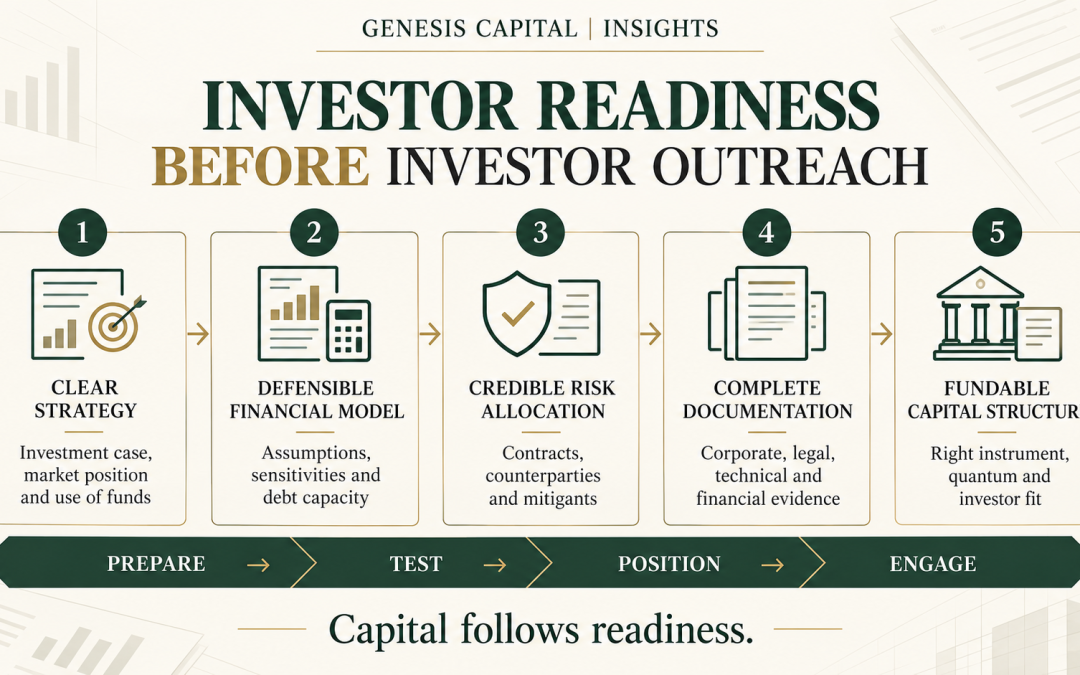
Five areas are particularly important.
1. A clear strategy
An investor should be able to understand the opportunity without having to reconstruct the business case.
The company or project sponsor should be able to explain:
- What the business or project does;
- Why the opportunity exists;
- How it is positioned within its market;
- How much capital is required;
- How the funds will be used; and
- What milestones the capital will enable.
The funding requirement should connect directly to a credible plan for growth, completion or risk reduction. If the transaction cannot be articulated clearly, it will be difficult for an investor to assess or support it.
2. A defensible financial model
A forecast is not sufficient merely because it shows attractive revenue, profit or valuation.
Investors will examine the assumptions underlying the numbers, including pricing, volumes, operating costs, capital expenditure, working capital, taxation, financing requirements and cash generation. For debt transactions, they will also assess repayment capacity under different operating conditions.
A credible model should be internally consistent, supported by identifiable assumptions and capable of showing what happens when performance is weaker than expected.
The objective is not to produce the most optimistic outcome. It is to demonstrate that management understands the financial drivers and can explain how the business performs under both base-case and downside scenarios.
3. Credible risk allocation
Institutional capital does not expect a risk-free opportunity. It does, however, expect the principal risks to be understood and allocated appropriately.
Depending on the transaction, this may include:
- Construction and completion risk;
- Operating and performance risk;
- Revenue or offtake risk;
- Regulatory and permitting risk;
- Technology risk;
- Currency and interest-rate exposure; and
- Counterparty risk.
Investors will want to know who bears each risk, whether that party has the capacity to manage it and what contractual or structural protection exists if something goes wrong.
4. Complete and consistent documentation
A teaser or presentation may open the door, but supporting evidence keeps it open.
The required information will vary, but it commonly includes corporate records, ownership details, financial statements, licences, technical studies, commercial contracts, legal documentation, capitalisation information and a detailed financial model.
Conflicting figures, outdated presentations and incomplete documents create avoidable uncertainty. A properly organised data room, clear version control and a list of outstanding items can materially improve the efficiency of the review process.
Where information is still pending, that should be disclosed together with the responsible party and expected completion date.
5. A fundable capital structure
A strong business is not automatically a fundable transaction.
The proposed amount, instrument, maturity, security package and expected return must be appropriate for the opportunity’s cash flows, development stage and risk profile. The sponsor’s own financial commitment and the proposed use of funds must also be clear.
The right capital structure may involve equity, senior debt, subordinated capital, guarantees, strategic investment or a combination of instruments. The structure should reflect the commercial reality of the opportunity rather than simply the sponsor’s preferred form of capital.
The cost of approaching investors too early
Premature investor outreach can create several problems:
- The first impression is weakened by incomplete or inconsistent information;
- Management spends time responding to questions it is not yet prepared to answer;
- Investors may suspend their review before the opportunity is properly presented;
- Different versions of the transaction may begin circulating in the market; and
- Valuable investor relationships may be used before the opportunity is genuinely actionable.
Investor networks are finite. They should be approached selectively and only when there is a credible basis for engagement.
Readiness does not require perfection
Development-stage companies and projects will inevitably have unresolved matters. Sophisticated investors understand this.
What matters is the distinction between a risk that has been identified and is being managed, and a risk that has not been recognised or disclosed. A credible sponsor should be able to state what is complete, what remains outstanding, how each open matter will be resolved and what impact it may have on the transaction.
The appropriate sequence is therefore:
Prepare. Test. Position. Engage.
Capital raising becomes more effective when investor outreach is the result of a disciplined preparation process—not the starting point.
Genesis Capital works with businesses and project sponsors to assess investor readiness, strengthen transaction structures and position suitable opportunities for institutional capital.
This article is provided for general information and does not constitute investment, legal, tax or financial advice.