
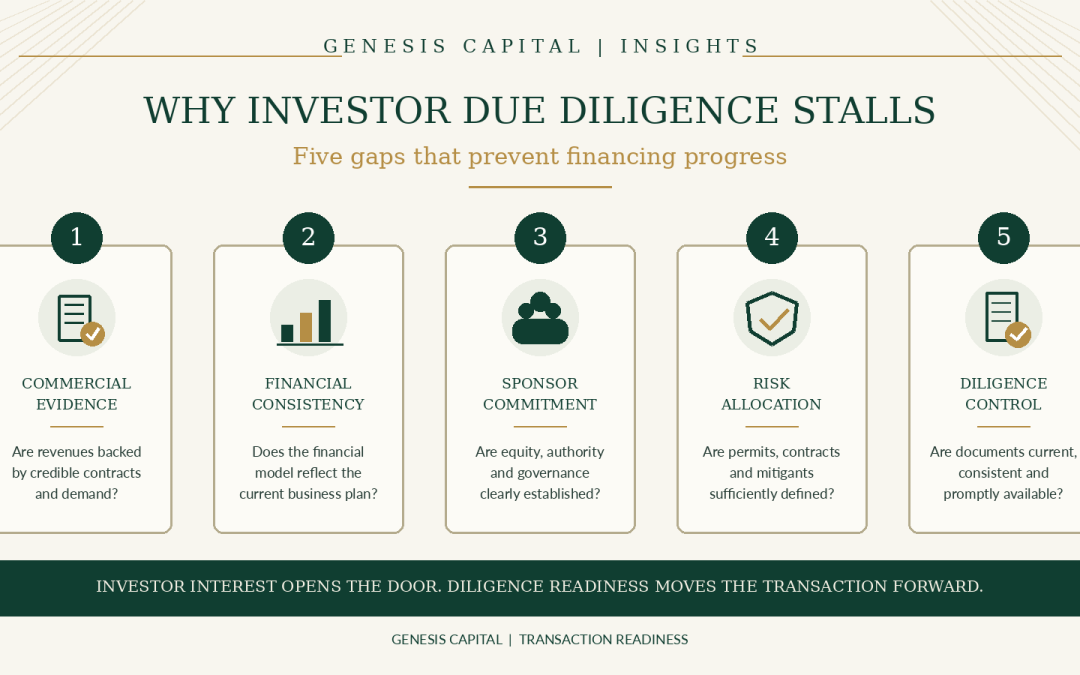
Why a positive investor meeting does not necessarily lead to a financing commitment
A successful first meeting with an institutional investor can create considerable optimism for a company seeking growth capital or a sponsor developing an infrastructure project.
The investor understands the opportunity. The proposed capital requirement appears to fit its investment mandate. Preliminary discussions are encouraging, and a request for additional information follows.
Yet several months later, the transaction may have made little progress.
No indicative proposal has been issued. The investor continues to request clarification. Financial assumptions are being revised, documents remain outstanding, and the anticipated financing timetable has moved repeatedly.
The sponsor may attribute the delay to investor bureaucracy or changing market conditions.
Sometimes those explanations are justified. Institutional investment processes can involve lengthy internal approvals, investment committees, external advisers and regulatory requirements.
However, many transactions stall for a more fundamental reason.
The opportunity was sufficiently attractive to generate interest but insufficiently prepared to withstand detailed underwriting.
Investor interest is an important milestone. It is not evidence that a project is financeable.
Understanding the difference is essential for companies and project sponsors preparing to raise institutional capital.
1. Commercial assumptions cannot be independently substantiated
The first major problem arises when projected revenue is supported by an attractive market narrative but limited contractual or operational evidence.
A financial presentation may demonstrate strong demand, substantial market growth and promising expected returns.
However, institutional investors need to determine which assumptions are supported by verifiable evidence.
For an established business, this may involve reviewing historical revenue, customer concentration, contracts, collections and profitability.
For a renewable-energy project, it may require examining the electricity purchase agreement, offtaker creditworthiness, tariff structure and transmission arrangements.
For a data centre, it may involve assessing tenant commitments, contracted capacity, power availability and realistic occupancy assumptions.
These distinctions matter because market demand is not equivalent to contracted revenue.
Similarly, a letter expressing commercial interest may provide useful validation without creating an enforceable purchase or payment obligation.
During diligence, investors may seek customer contracts, independent market studies, relevant operating evidence and confirmations from counterparties.
If these materials are unavailable, the investment case may require substantial revision.
The critical question is not whether the opportunity has commercial potential, but whether its revenue assumptions can withstand independent scrutiny.
What sponsors should prepare
A credible commercial evidence package should identify major customers or counterparties, contractual commitments, pricing assumptions, the expected timing of revenue and the principal risks to collection.
Where material contracts remain unsigned, the financing case should distinguish prospective revenue from committed revenue.
That transparency allows investors to assess development risk rather than discovering it unexpectedly during diligence.
2. The financial model does not reconcile with the business plan
A second common weakness is the gap between the sponsor’s commercial narrative and its financial model.
A presentation may refer to a particular development cost, projected operating margin or funding requirement, while the supporting model contains different assumptions.
Capital expenditure may have increased without a corresponding revision to the financing plan.
Construction schedules may assume completion dates that are no longer achievable.
Revenue projections may reflect customers or contracts that have not materialised.
In other cases, the financial model may contain a detailed valuation without sufficient evidence supporting the underlying forecasts.
Such inconsistencies can become significant obstacles during institutional diligence.
Investors are not simply looking for attractive projected returns. They need to understand how those returns are generated and how sensitive they are to changes in the underlying assumptions.
A defensible financial model should connect the commercial plan to capital expenditure, operating expenses, working capital, funding requirements and investor returns.
For debt transactions, it should also demonstrate how projected cash flows support scheduled repayment obligations.
For equity transactions, investors will examine valuation assumptions, dilution, future funding requirements and potential exit scenarios.
What sponsors should prepare
Before opening a data room, management should reconcile the business plan, investment presentation and financial model.
The model should incorporate sensitivity scenarios involving revenue, costs, construction delays, interest rates and other material transaction risks.
The objective is not to eliminate uncertainty.
It is to demonstrate that the sponsor understands how uncertainty affects financing outcomes.
A model that can only support the investment case under optimistic assumptions is unlikely to provide a sufficient foundation for institutional underwriting.
3. Sponsor commitment and financing authority remain uncertain
A third obstacle concerns the sponsor itself.
Investors assess the project or company, but they also assess the people responsible for delivering the transaction.
They need confidence that the sponsor has the financial capacity, authority, governance arrangements and operational commitment necessary to execute the proposed plan.
A transaction may encounter difficulties when the sponsor’s equity contribution is unclear, shareholder approvals remain outstanding or financing discussions are being conducted without confirmed authority.
In development-stage infrastructure, sponsor equity can be particularly important.
Lenders may require evidence that the equity component is committed and available on an agreed funding schedule.
An investor may also need to understand whether existing shareholders are prepared to accept the dilution, governance rights, security arrangements or other conditions associated with the proposed financing.
Unresolved ownership disputes, unclear decision-making authority or inconsistent expectations among shareholders can materially complicate execution.
What sponsors should prepare
Institutional diligence generally benefits from clear corporate ownership records, financial information on material sponsors, an agreed funding plan and evidence of relevant transaction approvals.
Management should also identify who is authorised to negotiate and execute transaction documents.
For projects involving several sponsors or joint-venture participants, these matters should be resolved before advanced financing discussions.
Sponsor credibility is demonstrated through commitment, decision-making capacity and execution discipline—not simply through the strength of the project concept.
4. Contractual, regulatory and technical risks have not been allocated
A fourth reason for financing delays is the discovery of important risks that have not been addressed contractually or technically.
Infrastructure investments are particularly sensitive to the allocation of construction, operating, payment, regulatory and political risks.
An attractive project may still lack finalised land rights, required permits, credible construction arrangements or a bankable operating framework.
Consider a hypothetical renewable-energy development.
The project may have suitable land, a technically viable design and a credible estimate of electricity demand.
However, if its electricity purchase agreement is unsigned, transmission rights are unresolved and completion obligations have not been properly allocated, lenders may be unable to establish an acceptable financing structure.
Similarly, a digital-infrastructure development may have a compelling commercial proposition but remain dependent on uncommitted electricity supply, unresolved connectivity rights or customers that have not entered into binding agreements.
The challenge is not necessarily that the project is unattractive.
It is that investors cannot determine who will absorb the consequences if material assumptions prove incorrect.
The International Finance Corporation’s published project-financing criteria emphasise technical soundness, financial viability and environmental and social requirements. Its investment process also involves detailed assessment of the project’s risks, business potential and ability to meet applicable standards.
These assessments extend well beyond the initial investment presentation.
What sponsors should prepare
A transaction-readiness review should identify the principal risks and the party responsible for managing each of them.
Relevant evidence may include construction contracts, operating arrangements, permits, licences, insurance requirements, regulatory approvals and contractual protections.
Material unresolved risks should be explicitly disclosed, together with a practical mitigation plan.
Investors can evaluate disclosed development risks. Unexpected omissions discovered late in diligence are considerably more damaging to confidence.
5. The data room exists, but the diligence process is not controlled
The fifth weakness is frequently operational rather than financial.
A sponsor may have assembled a substantial collection of documents but still be unprepared to manage an institutional diligence process.
Files may be outdated, incomplete or inconsistently named.
Different versions of the financial model may be circulating among advisers and investors.
Requests may be answered through multiple email chains without a central record of what has been supplied.
Important documents may exist, but management cannot locate them promptly.
The result is a process characterised by repeated questions, inconsistent responses and unnecessary delays.
An effective data room is therefore more than a repository of documents.
It is part of a controlled transaction process.
What sponsors should prepare
The data room should contain current, appropriately approved versions of material corporate, commercial, financial, legal, technical and regulatory documents.
Every significant document should have an identifiable owner and, where relevant, a clear version date.
A central diligence tracker should record each investor request, responsible person, expected response date, status and any outstanding dependencies.
Responses should be consistent with the investment presentation and financial model.
The sponsor should also distinguish completed documentation from materials that remain under negotiation or preparation.
This allows investors to identify real transaction issues without confusing them with administrative gaps.
6. Why transaction momentum matters
Institutional financing typically progresses through several stages.
Following initial interest, investors may undertake preliminary screening, management meetings, information review, formal due diligence, investment committee consideration, negotiations and documentation.
The precise sequence varies by institution and financing instrument.
Each stage can introduce new requirements.
An indicative financing proposal may depend on further diligence. A term sheet may contain conditions that remain unresolved. Internal approval may still be necessary before legally binding commitments can be issued.
The International Finance Corporation’s project cycle illustrates that appraisal, investment review, negotiations and approval are distinct stages involving progressively deeper analysis.
For sponsors, this means that completing an investor meeting or receiving a positive preliminary response should not be confused with financing certainty.
Momentum must be supported by credible answers and continuous progress.
Repeatedly postponing delivery of critical materials can make it difficult for investors to maintain the transaction within their active investment pipeline.
Market conditions, investment priorities and available capital can also change while a transaction remains stalled.
7. A practical transaction-readiness test before formal diligence
Before inviting an investor into a full diligence process, the sponsor should be able to answer five questions.
Can the projected revenue be supported?
Commercial assumptions should be supported by contracts, operating evidence, independent analysis or clearly identified development milestones.
Does the financial model represent the current transaction?
Capital requirements, timelines, commercial assumptions and proposed financing instruments must be internally consistent.
Is the sponsor ready to commit and execute?
Ownership, authority, governance and required sponsor funding should be established.
Are material risks identified and allocated?
The investment case should explain major commercial, legal, technical, regulatory and operational risks and how they will be mitigated.
Can the management team sustain institutional diligence?
The data room, responsibilities, response process and documentation should be organised before substantial investor engagement begins.
A negative answer does not automatically mean the underlying opportunity lacks merit.
It may indicate that the project should remain in development rather than proceed immediately to fundraising.
That distinction can protect both sponsor resources and institutional investor relationships.
8. When an adviser should recommend pausing fundraising
A capital adviser adds value not only by identifying potential investors but also by recognising when continued outreach is premature.
There are circumstances in which repeated investor contact will produce diminishing returns.
Examples include a material funding gap without committed sponsor equity, repeatedly changing financial assumptions, unresolved regulatory approvals or commercial contracts that are essential to the proposed financing but remain unexecuted.
In such circumstances, the appropriate recommendation may be to suspend active fundraising until the principal deficiencies have been addressed.
This is different from abandoning the opportunity.
It is a decision to focus resources on the actions most likely to improve financeability.
A targeted readiness programme may involve completing the financial model, securing commercial commitments, resolving ownership or permitting matters, documenting risks or organising the data room.
Once material deficiencies have been addressed, investor engagement can resume with a stronger transaction proposition.
Conclusion: Diligence readiness is an execution capability
Institutional investors evaluate more than projected financial returns.
They assess commercial evidence, the credibility of management, sponsor commitment, contractual protections and the ability to execute a transaction under demanding conditions.
A positive initial investor response is only the beginning.
Progress toward financing commitment depends on whether the sponsor can substantiate the investment case and respond effectively to increasing levels of scrutiny.
The objective is not simply to secure investor attention.
It is to create a transaction capable of progressing from initial interest through diligence, approval, documentation and ultimately funding.
Investor interest opens the door. Diligence readiness determines whether the transaction moves through it.
Genesis Capital perspective
Genesis Capital advises project sponsors and businesses on institutional investment readiness, financing structures, risk allocation and access to suitable capital providers.
Our approach is to evaluate the transaction before extensive fundraising, identify material bankability deficiencies and support a disciplined engagement process with appropriately matched investors and lenders.
For sponsors preparing a capital raise, resolving diligence weaknesses early can help reduce avoidable delays, protect investor confidence and improve transaction execution.
Related LinkedIn discussions:
Capital Raising Requires Commercial Evidence, Not Just Investor Access — Puneet Narula
Why Sponsor Responsiveness Matters During Investor Due Diligence — Roger Lee
Further reading:
International Finance Corporation — How to Apply for Financing
International Finance Corporation — Project Investment Cycle
This article is intended for general information and does not constitute investment, financial, legal or tax advice. Financing requirements vary by investor, jurisdiction, instrument and transaction.