
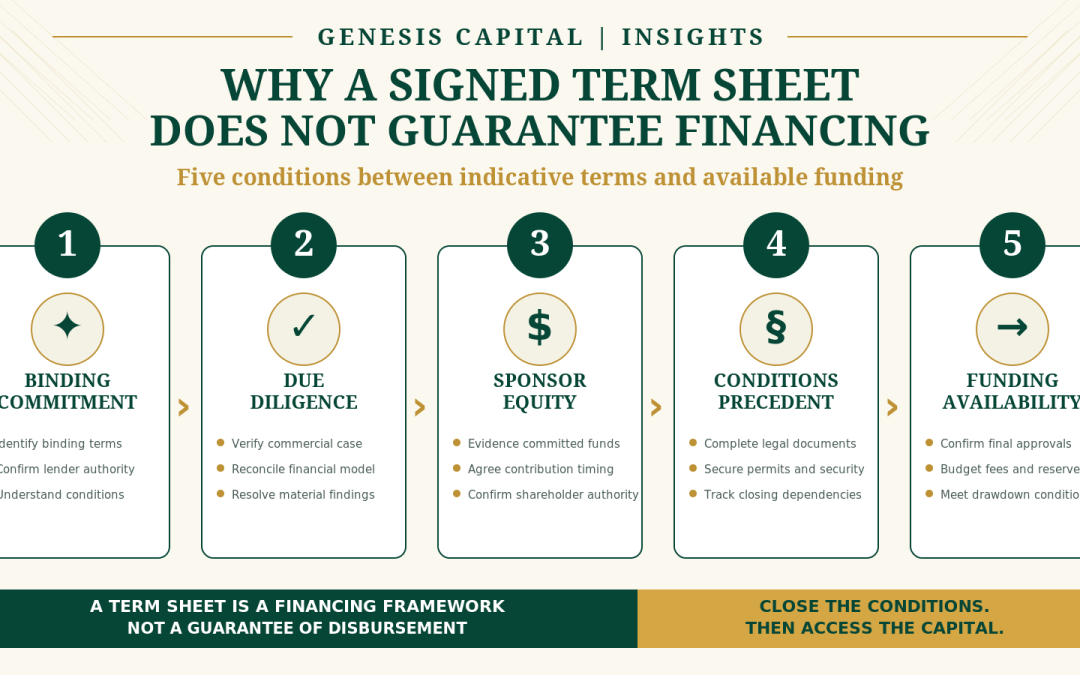
Five conditions that can prevent an apparently successful capital raise from reaching financial close
For many project sponsors and businesses seeking institutional capital, receiving a term sheet represents a major achievement.
After months of discussions, presentations and investor engagement, a prospective lender or investor has outlined the financing it may be prepared to provide.
The proposed amount is substantial. The financing terms appear commercially workable. The anticipated closing timetable is discussed, and the sponsor begins planning for execution.
Yet a term sheet does not necessarily mean the funding has been secured.
Between initial agreement on commercial terms and the actual availability of capital lies a process involving due diligence, documentation, approvals, contractual requirements and financial commitments.
Any unresolved issue can delay the transaction. Some can prevent it from proceeding altogether.
A term sheet demonstrates a proposed financing framework. It does not, by itself, establish that money will be available for drawdown.
Understanding this distinction is essential for sponsors who need to manage contractors, development expenditure, shareholder expectations and transaction timetables.
1. Understand what the term sheet actually commits the investor to do
The first question is whether the document creates a legally binding financing obligation.
Many term sheets are indicative and expressly subject to further due diligence, internal approvals, satisfactory documentation and other conditions.
They may contain provisions that are binding, such as confidentiality, exclusivity, expenses or governing-law arrangements, while leaving the principal financing commitment non-binding.
A document can therefore create contractual obligations for the sponsor without obligating the investor to provide the proposed financing.
This distinction deserves careful attention.
Consider a hypothetical infrastructure sponsor seeking $120 million of project debt.
A lender issues an indicative term sheet identifying the amount, pricing, maturity, security and expected financing timetable.
The sponsor signs the document and announces that financing has been secured.
However, if the term sheet expressly remains subject to credit approval, satisfactory due diligence and definitive financing documentation, the lender may not yet have committed to advance any funds.
The sponsor’s public statements and commercial decisions may therefore be premature.
Before signing, the sponsor and its legal advisers should establish which provisions are binding, what approvals remain outstanding and whether the lender has any enforceable funding obligation.
Signing a term sheet and securing committed financing are not equivalent events.
2. Outstanding due diligence can change the financing terms
The second major obstacle is incomplete due diligence.
A lender may have reviewed a preliminary financial model and investment presentation before issuing indicative terms.
During formal diligence, its advisers may examine the project’s commercial agreements, regulatory position, construction arrangements, financial assumptions, ownership and security structure in much greater detail.
This process can reveal information that materially changes the lender’s assessment.
A construction budget may increase.
The proposed completion schedule may prove unrealistic.
A major customer commitment may be less certain than originally represented.
The financial model may overstate revenue or underestimate working-capital requirements.
Where these findings affect the lender’s risk exposure, the original financing terms may need to be reconsidered.
The lender could request additional sponsor equity, greater security, revised pricing, stronger guarantees or a lower financing amount.
In more serious cases, diligence findings may lead the investor to withdraw.
This is why sponsors should avoid treating a term sheet as validation of every underlying project assumption.
The International Finance Corporation’s investment process distinguishes appraisal, negotiations, approvals, legal commitment and disbursement. Each stage has its own requirements.
An encouraging financing proposal is therefore only one part of a wider institutional investment decision.
What sponsors should do
Before requesting definitive financing terms, sponsors should complete the most important commercial, technical, financial and legal readiness work.
The transaction should have a credible financial model, evidence supporting projected revenue, a clear development timetable and an organised data room.
Material unresolved issues should be disclosed rather than left for lenders to discover.
3. Sponsor equity and funding contributions must be demonstrably available
The third potential obstacle concerns the sponsor’s own financial commitment.
Infrastructure lenders frequently require sponsors to contribute equity as part of the financing structure.
The amount, timing and form of that equity can determine whether the proposed debt financing is executable.
Suppose a hypothetical project requires $160 million of total funding, consisting of $40 million in sponsor equity and $120 million in debt.
The lender may be satisfied with this proposed capital structure in principle.
However, if the sponsor cannot demonstrate that the $40 million equity contribution is committed and available on the required timetable, the lender may be unable to proceed.
A sponsor may propose to raise its equity only after debt terms have been agreed.
That approach creates execution uncertainty, particularly where both capital providers expect the other financing component to be committed first.
The issue can become more complicated if the proposed equity includes land contributions, previously incurred development costs, shareholder loans or investments from third parties that have not yet signed binding agreements.
Such contributions may not be accepted at the sponsor’s stated value or treated as qualifying equity under the financing documents.
What sponsors should do
Before progressing to formal financing documentation, sponsors should establish:
- The total amount of equity required.
- The amount already invested and how it will be recognised.
- The sources of additional equity.
- The contractual status of those commitments.
- The required contribution timetable.
- The consequences if equity is delayed.
Financing readiness requires more than an agreed debt-to-equity ratio.
It requires evidence that the proposed capital structure can actually be funded.
4. Conditions precedent can prevent financial close or drawdown
The fourth obstacle is the failure to satisfy conditions precedent.
These are contractual requirements that must be fulfilled before a specified right or obligation becomes effective.
In project financing, conditions precedent may apply to the effectiveness of agreements, financial close or individual loan disbursements.
Common examples include executed project contracts, regulatory approvals, perfected security, insurance, satisfactory legal opinions and evidence of sponsor equity.
For a renewable-energy project, conditions may involve an effective power purchase agreement, grid-connection arrangements, land rights and construction documentation.
For a data-centre development, they may include power availability, site rights, material customer arrangements, construction contracts and relevant permits.
The exact requirements depend on the transaction and financing agreements.
The World Bank’s guidance on public-private partnership financing makes an important distinction: completion of the principal commercial contract does not necessarily mean the project has reached financial close.
Outstanding financing documents, permits, approvals and other conditions may still need to be completed before funding becomes available.
This is particularly important where the completion of one condition depends on another party.
A lender may require an effective concession agreement.
The concession agreement may itself require evidence of committed financing.
These interdependent obligations can create difficulties unless the closing process is carefully coordinated.
What sponsors should do
A conditions-precedent register should be maintained from the beginning of formal financing negotiations.
Each condition should have an owner, required supporting evidence, target completion date, dependency and current status.
Critical requirements controlled by government authorities, commercial counterparties or third-party advisers should be identified early.
Sponsors should distinguish requirements that can be completed before signing from those that can only be fulfilled at financial close or before a particular disbursement.
5. Financing costs, guarantees and closing obligations may be underestimated
The fifth obstacle is the cost and operational burden of completing the financing.
A term sheet may require payment of due-diligence expenses, arrangement fees, commitment fees or other charges.
Additional costs may arise from legal advisers, technical consultants, insurance reviews, valuation work and financial modelling.
Some transactions also require performance guarantees, reserves, security arrangements or other financial commitments.
These obligations should be understood before the sponsor accepts the proposed financing timetable.
Consider a transaction where a lender’s indicative terms require a mobilisation payment shortly after signing, followed by external due-diligence expenses and additional conditions before financial close.
The sponsor must distinguish between legitimate transaction expenses and any actual financing commitment.
Paying a fee does not necessarily mean the lender has approved the financing.
Neither does it guarantee that the transaction will reach closing.
The sponsor should understand who receives each payment, what services it covers, whether it is refundable, what happens if the financing fails and whether the amounts are commercially reasonable.
A material upfront payment to an unfamiliar intermediary or financing provider should also trigger appropriate counterparty verification and independent legal review.
What sponsors should do
The financial model and transaction budget should include anticipated financing-related expenditure.
Any payment obligations should be reviewed alongside the binding status of the term sheet, the lender’s credentials, its approval process and the conditions for advancing funds.
The cost of pursuing financing must be assessed independently from the probability of receiving it.
6. Internal credit approval is not the same as funding availability
Even after satisfactory diligence, an institutional investor may require further internal approvals.
These can involve credit committees, investment committees, boards or other authorised decision-makers.
A favourable recommendation by the deal team does not necessarily constitute final approval.
Likewise, formal approval may still be conditional on documentation, completion of outstanding requirements or the absence of material adverse developments.
The International Finance Corporation’s disclosed investment stages illustrate this distinction.
A project can be approved but not yet signed. It can also reach legal commitment while funds remain undisbursed.
This is a useful reminder that institutional financing progresses through separate decision points.
Sponsors should therefore ask which authority has approved the investment, what conditions remain and what must happen before legally committed funds become available.
A realistic closing forecast should reflect those remaining steps rather than assuming that all approvals occur simultaneously.
7. The difference between financial close and first drawdown
The terminology used in financing discussions can create misunderstandings.
In a conventional project-finance context, financial close generally refers to the point at which financing documentation has been executed and the relevant conditions for financing availability have been fulfilled or waived.
The World Bank’s project-finance guidance describes financial close as the stage when financing becomes available for drawdown.
Actual disbursement may take place at financial close or subsequently, according to the contractual drawdown process.
For a project involving construction, funding may be released in stages against defined expenditure, milestones or other conditions.
This distinction matters because contractors, suppliers and project sponsors ultimately depend on accessible funds rather than indicative financing amounts.
A project should not assume immediate liquidity merely because an investor has issued an approval or signed a legal agreement.
The sponsor should understand the initial drawdown requirements, the expected funding sequence and any restrictions on the use of proceeds.
8. Five practical questions before signing a term sheet
A sponsor evaluating indicative financing terms should ask five questions.
1. Is the financing commitment legally binding?
Identify which provisions are binding and which remain conditional.
2. What due diligence and approvals are still required?
Establish whether the investor has completed underwriting and whether final authority has approved the transaction.
3. Is the sponsor’s equity fully committed and available?
Confirm the amount, source, timing and acceptability of the proposed equity contribution.
4. What conditions must be met before financial close and disbursement?
Prepare a complete list of outstanding requirements and identify the party responsible for each.
5. What costs and obligations arise before funding is available?
Understand due-diligence expenses, fees, guarantees, reserves and other financial commitments.
A sponsor able to answer these questions is better placed to distinguish a promising financing proposal from an executable transaction.
9. Managing the period between term sheet and financial close
The period following a term sheet should be managed as a formal transaction-execution process.
The sponsor, financial adviser, legal counsel and relevant technical advisers should establish a clear timetable and allocate responsibility for every outstanding requirement.
A central tracker should record diligence requests, document status, approval milestones, conditions precedent, fees and expected drawdown timing.
Weekly progress reviews can help identify emerging delays.
However, simply reporting that financing discussions remain ongoing is insufficient.
A meaningful progress report should identify what has been completed, what remains unresolved, who is responsible and when the next decision is expected.
Where material delays occur, the sponsor should reassess the closing timetable rather than continuing to communicate an unrealistic target date.
Investor relationships benefit from accurate information and disciplined execution.
Conclusion: The transaction is not financed until the financing can be executed
Receiving a term sheet can be an important commercial achievement.
It demonstrates that a prospective capital provider is prepared to discuss financing on an identifiable set of terms.
However, the path from indicative terms to financial close requires substantially more work.
Due diligence must support the investment case.
The sponsor’s funding commitments must be credible.
Legal documentation, regulatory requirements and contractual conditions must be completed.
Approvals must be obtained, and the conditions for accessing funds must be satisfied.
The most effective sponsors treat these requirements as part of the financing strategy from the outset.
The objective is not to obtain a term sheet. It is to reach financial close on terms that can actually be implemented.
Genesis Capital perspective
Genesis Capital advises project sponsors and businesses on transaction readiness, financing structures, institutional investor engagement and the execution requirements that stand between preliminary financing interest and financial close.
Our approach emphasises sponsor commitment, bankable documentation, credible financial models, risk allocation and disciplined management of financing conditions.
For project sponsors, a financing proposal should be assessed not only by its headline amount and pricing but also by the probability, cost and practical requirements of achieving financial close.
Further reading:
International Finance Corporation — Project Cycle
World Bank — Achieving Contract Effectiveness and Financial Close
International Finance Corporation — Disclosure Portal: Project Statuses
This article is for general information and does not constitute legal, investment, tax or financial advice. Financing commitments, conditions precedent and financial-close requirements vary by transaction, instrument and jurisdiction.